How to Stop Overthinking During Sex: 8 Ways to Switch Your Brain Off

To stop overthinking during sex, give your attention one simple job: notice your breath, then one physical sensation, and come back to it each time a thought pulls you away. Slow the pace, take the pressure to orgasm off the table, and say worries out loud instead of hiding them. Practised often, this gets easier.
Part of our guide: Female Pleasure and Orgasm: The Complete Guide
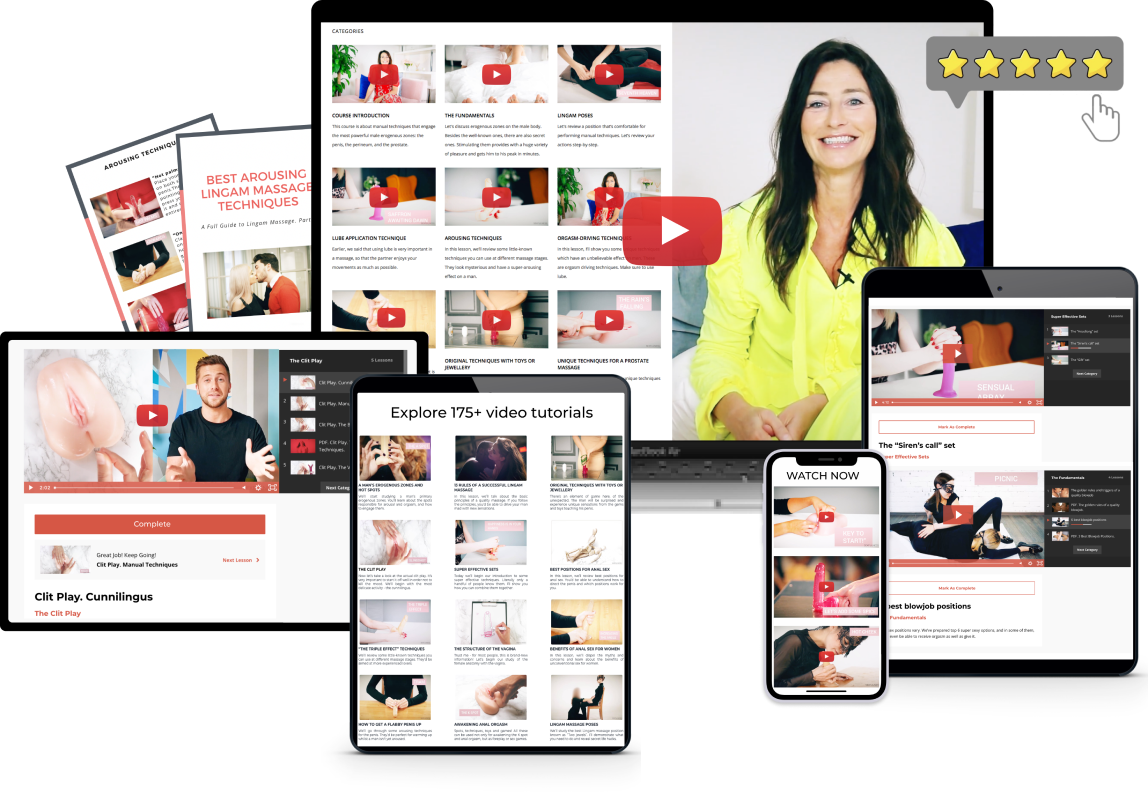
Switching off is easier to learn when you can see and hear someone guide you through it. In our video course Sleeping Beauty there is a whole lesson on switching your brain off during sex, so you can watch tonight and try it the same evening.
Key takeaways
- Watching and judging yourself during sex has a name, "spectatoring", and it is very common.
- You cannot force thoughts to stop, but you can keep bringing attention back to your body.
- Breath, slower touch and removing the goal of orgasm are the most reliable ways back in.
- Saying a worry out loud usually makes it smaller, and a kind partner can help a lot.

From the video course Sleeping Beauty: How to Awaken a Woman’s Orgasm
Video course
Sleeping Beauty: How to Awaken a Woman’s Orgasm
17 short video lessons · 7-day practice plan · certificate
Quiet the mental chatter, relax into your body and let pleasure build at its own pace.
Private account · watch on any device · cancel any time
In this guide
Why do I overthink during sex?
Usually because part of you is watching and judging, instead of feeling. That is normal, and it can be retrained.
Sex researchers William Masters and Virginia Johnson (1970) called this "spectatoring": stepping outside yourself to check how you look, how you are doing, or whether you will finish. While you are busy watching, there is less attention left for touch.
Later research backs this up. Dove and Wiederman (2000) found that women who were more distracted by worries about their appearance or performance during sex reported less satisfaction and less consistent orgasm.
A helpful way to picture it is the dual control model (Bancroft and Janssen, 2000). Arousal has an accelerator and a brake. Stress, self-criticism and to-do lists press the brake. Often the fix is not more stimulation, but taking your foot off the brake.
How do you stop overthinking during sex? 8 ways
Give your mind a simple, physical task, lower the pressure and slow everything down. Pick one or two of these to start with, not all eight at once.
1. Notice the thought, then come back
Don't fight the thought. Silently label it, "planning" or "judging", and return to one sensation, such as the warmth of a hand on your back. This simple loop is the heart of mindfulness, and you may need to repeat it many times. That is the practice working, not failing.
2. Use your breath as an anchor
Breathe in through your nose, then let a long, slow breath out through your mouth. A longer exhale tends to feel calming. Let your belly soften as you breathe out.

You can see breathing patterns like this demonstrated in the lessons “Orgasm breathing. Part 1” and “Part 2”. Our article on orgasm breathing explains the basics.
3. Do a five-senses check-in
Name, silently, one thing you can feel, hear, smell, see and taste. It takes about 20 seconds and pulls attention out of your head and into the room.
4. Take orgasm off the table for tonight
Agree that tonight is only about touch that feels good, with no finish line. This is the idea behind sensate focus, the touch exercises Masters and Johnson (1970) developed for exactly this kind of pressure. Our sensate focus exercises guide shows the stages.
5. Set the room up for comfort
If you worry about how you look, change what you can: softer light, a warm room, a sheet over you, a position where you feel relaxed. Body worries are a common source of spectatoring, so comfort is not vanity. It is part of the method.
6. Say the thought out loud
A worry kept secret tends to get louder. Try one honest, light sentence: "My head is busy tonight, can we slow down?" Most partners are relieved to know what is going on.
7. Slow the pace right down
Rushing feeds anxious thinking. Slower touch gives your body time to catch up with your mind. Learning the stages of female arousal helps here, because it shows why a slow build is not "taking too long".
8. Make a small bridge from your day
Going straight from emails to bed is hard. A shower, a few minutes of music or a slow kiss on the sofa can act as a bridge. The lesson “When is the best time to awaken sexuality” looks at timing in more detail.
🎥 Want to see it done step by step?
In Sleeping Beauty you can watch lessons such as “How to switch your brain off during sex”, “Orgasm breathing. Part 1” and “Stages of arousal”, each explained calmly, one step at a time.
Watch the course trailer
Private account · watch on any device · cancel any time
What thoughts get in the way most often?
Most fall into three groups: how I look, how I am doing, and everything else in my life. Spotting the group makes it easier to pick the right reset.
| Thought | What it does | Try this |
|---|---|---|
| "How do I look from this angle?" | Moves attention from feeling to watching | Softer light, a position you feel good in, eyes closed |
| "Am I taking too long?" | Adds pressure, which presses the brake | Take orgasm off the table for tonight |
| "Is this good for them?" | Turns sex into a test | Ask one simple question, then trust the answer |
| "I forgot to reply to that email" | Pulls you back into your day | A short bridge ritual before bed, then the breath anchor |
What we teach in the course
Three things from the course that most articles on overthinking skip:
- Mindset comes before technique. The course puts the lesson “How to switch your brain off during sex” early, before any of the lessons on erogenous zones or types of orgasm.
- The breath gets its own module. You learn 4 types of orgasm breathing, so you have a physical anchor ready, not just the advice to "relax".
- Understanding the "why" lowers the pressure. The lessons “Why there's no orgasm” and “Stages of arousal” explain what is happening in the body, which makes a slow build feel normal instead of worrying.
✅ Try tonight: 3 small steps
- Before you start, tell your partner: "Tonight there is no goal, just touch."
- Take five slow breaths with a long exhale, hands on each other's chest.
- Each time a thought arrives, name it silently and return to one sensation.
How can a partner help someone who overthinks in bed?
By making it safe to slow down, pause or say "I'm in my head" without any sign of disappointment.

- Lead with reassurance. "There is no rush" is one of the kindest things you can say in bed.
- Slow, broad touch first. Back, arms and thighs before more intimate areas.
- Ask simple questions. "Softer or the same?" is easier to answer than "What do you want?"
- Don't take a pause personally. A pause is information, not rejection.
Consent matters here too. Either of you can slow down or stop at any point, and if anything hurts, stop. Our guide on how to make love slowly has more ideas for a relaxed pace.

Is overthinking during sex a sign of a problem?
Usually not. A busy mind in bed is a common experience, not a diagnosis.
Still, the NHS lists stress, anxiety and depression among the main causes of a low sex drive. Mindfulness has good evidence behind it too: in a study by Brotto and Basson (2014), women with low desire who took part in group mindfulness sessions reported improved desire and arousal.
If worry is constant, or spills into the rest of your life, it is worth getting support rather than pushing through on your own.
When to see a GP or doctor
- Anxiety, low mood or worry that affects your daily life, not only sex. NHS talking therapies can help, and in England you can often refer yourself.
- Low desire that worries you or does not improve, especially after starting a new medicine or contraception.
- Pain during sex. Stop, and get it checked rather than trying to relax through it.
- Erection problems that keep happening. The NHS notes stress and anxiety are common causes, but a GP can check for physical ones.
Not sure where to start? Take the free 2-minute Pleasure Quiz and get ideas that suit you.
“I feel super confident and positive now.”
Kristen, from our reviews
Learn it faster with video lessons
Reading gives you the map. Watching gives you the feel. In Sleeping Beauty you hear how the breathing should sound, see the pace and understand what is happening in your body as arousal builds.
What you'll be able to do after 7 days
- Notice when you start spectatoring and gently bring yourself back.
- Use a few types of orgasm breathing as an anchor during sex.
- Understand your own arousal well enough to stop rushing it.
What's included
- 17 short lessons, each one explained and demonstrated on video
- A 7-day practice plan with one small step a day
- Private and discreet: watch on your own device, whenever suits you
- A certificate when you finish
or see everything included in full access
Private account · watch on any device · cancel any time
Frequently asked questions
Why can't I stop thinking during sex?
Thoughts arrive on their own, so trying to stop them rarely works. What helps is noticing a thought and returning to a sensation, again and again. With practice, the gaps between thoughts get longer.
Can overthinking stop me from having an orgasm?
It can make orgasm harder. Distraction and pressure act like a brake on arousal. Lowering the pressure and slowing down often helps more than trying harder.
Does mindfulness help with sex?
There is good evidence that it can. Research by Lori Brotto and colleagues found that mindfulness-based sessions improved sexual desire and arousal in women with low desire.
Should I tell my partner I overthink during sex?
Usually, yes. A simple, light sentence such as "My head is busy, can we slow down?" lets your partner help instead of guessing.
Is it easier to learn this from video?
For many people, yes. Breathing and pace are easier to copy when you can watch and listen. Our Sleeping Beauty video course has a lesson on switching your brain off and comes with a 7-day practice plan. This article is still a complete place to start.
Sources
- Masters, W. H. and Johnson, V. E. (1970). Human Sexual Inadequacy. Boston: Little, Brown.
- Dove, N. L. and Wiederman, M. W. (2000). Cognitive distraction and women's sexual functioning. Journal of Sex & Marital Therapy, 26(1), 67-79.
- Bancroft, J. and Janssen, E. (2000). The dual control model of male sexual response. Neuroscience & Biobehavioral Reviews, 24(5), 571-579.
- Brotto, L. A. and Basson, R. (2014). Group mindfulness-based therapy significantly improves sexual desire in women. Behaviour Research and Therapy, 57, 43-54.
- NHS: Low sex drive (loss of libido)
- NHS: Talking therapies
- NHS: Erectile dysfunction
How we write: our editorial standards
Last updated: November 2026